Thoughts
Your organization captures nothing from AI. It was built against it.
9 Jun 2026 · updated on 29 Aug 2026
Your people already capture the value of AI and your organization does not, and it is neither a lag nor a lack of resources: it is a matter of architecture, mapped by six conditions.
You have heard it for three years: to profit from AI, get ready. Invest, equip, train, deploy. A matter of resources and maturity.
The best-resourced organizations fail the most. The gain does not reward preparation. It rewards alignment.
This essay is the logical next step in a diagnosis I have been building since spring. I described how AI is cracking the three pillars of the economic system (Will capitalism survive AI?): ownership of the means of production spreading downward, salaried work hollowing out, value no longer flowing up the channels built to capture it. One question stayed open, the one that diagnosis raises and cannot close: under what conditions can an organization still turn the new power of its members into collective value? Here is what is taking shape. Hard observations first. Then case studies, from cutting-edge labs to an Alpine village. A grid, which I present as a hypothesis. And finally a price, the one nobody wants to name.
The gain is there. Just not where you're looking.
Your people capture the value of AI every day. Under your roof. Just not for you.
A round of introductions, a few weeks ago, in a training room. A participant describes what she has built with AI: an assistant that prepares the minutes of her town's committees, where she sits as an elected official, a bot that puts together grant applications for her sports club, a routine that produces the club's newsletter, and the itinerary for the yearly trip with friends she organizes, logistics included. She is glowing. Precise use cases, pride in the results, contagious energy. Then I ask her what she does with all this at her company, the one paying for the training, the one that employs her thirty-five hours a week. A silence. "Not much for now. I put forward some proposals, I'm still waiting for sign-off, that was four months ago."
I live this scene several times a month. The hundreds of professionals I support every year show me, with a regularity that rules out chance, the same trade-off: the new power AI gives them, they deploy it where it pays them back. The town hall where they hold office. The association where they volunteer. The household, where you repair the car, the washing machine, the laptop yourself, and every fault you fix is one expense less. The personal project in the evening. The employer, meanwhile, gets the crumbs.[1]
Look at where that power goes, and you already hold the grid in miniature. AI gives each person a new capability, in the sense the economist Amartya Sen gave the word: not one more skill, but the real freedom to do what one has reason to want to do.[2] And that capability, the individual invests first where they have a stake, their own and that of the groups they belong to, the ones where what they give comes back to them. The household, friends, the association, the town: so many collectives where their contribution benefits everyone, themselves included. The base of alignment is right there, at the most intimate scale. What remains is to understand why the company, so often, is left out of it.
What I observe in my rooms, research measures at the scale of the system. In 2025, across more than three hundred enterprise deployments of generative AI, MIT documented that 95% of pilot projects produce no measurable impact on the bottom line, for $30 to 40 billion invested.[3] I analyzed that statistical silence in detail in The revolution that never happened: the promised organizational revolution did not happen, and executives' spectacular announcements most often dress up something else.
But the same MIT report holds a second figure, and that one made far fewer headlines. While the official projects fail, employees have already crossed over. Only 40% of the companies studied had taken out an official subscription to a large language model. Yet in more than 90% of all the companies studied, employees report regularly using personal AI tools to do their work.[3]
And the report adds a sentence every executive should frame: this underground AI economy often returns more than the formal initiatives.[3] The tool brought by the individual, chosen by them, aligned with their real need, beats the deployment decided from above. It is the phenomenon I named and unfolded in BYOAI, when the worker brings the machine: Microsoft was already measuring in 2024 that 78% of AI users at work bring their own tools without waiting for their company.[4]
A study published in February 2026 on Korean workers measures this mechanism with rare precision. 51.8% of them use generative AI at work, their working time falls by 3.8%, and the correlation between the time saved and the output handed back to the employer is close to zero: the authors show that workers capture the efficiency gain first for themselves, as breathing room on the job, and that productivity statistics miss what they do with it.[5] The gain exists, it is measured, it is captured. Just not by the organization.
Let us state the observation in full. The gain from generative AI exists. It is documented, reproducible, sometimes spectacular. But it lodges at the scale of the individual and dissipates at the scale of the organization. Value is not what is missing.
The gain didn't disappear. It changed address.
Preparation predicts nothing
They sell you the audit, the roadmap, the plan. Look at the best-resourced: they capture the least.
Faced with this, the consulting market has a ready answer: you are not prepared enough. Not enough digital maturity, not enough data governance, not enough budget, no roadmap. Buy the audit, run the transformation plan, and the gain will come.
The data say the opposite. The MIT report finds that large companies, the ones with the most resources, the most pilots underway and the most dedicated teams, show the lowest rate of moving from pilot to scale. Mid-sized companies, less well-resourced, convert faster: 90 days on average between pilot and full deployment among the best.[3] If preparation predicted the gain, the best-prepared would win. They lose.
Now look at what becomes of the announced, quantified gains, the ones that make the press conferences. Klarna declared in 2024 that its AI assistant did the work of seven hundred customer-service agents. Eighteen months later, its CEO publicly admitted the switch had produced lower-quality service, and the company was rehiring humans.[6] IBM announced it had replaced hundreds of HR roles with its AI; its chief executive then clarified that the company's total headcount had in fact gone up, the savings reinvested elsewhere.[7]
Meta, finally, condenses the whole file by itself, in two acts. January 2025, act one: the group announces a 5% cut to its workforce, widely read as an AI effect; the internal memo attributes the decision to individual performance and announces the roles will be refilled within the year.[8] In fact, the company ends 2025 with close to 79,000 employees, up.[9] April 2026, act two: this time Meta announces it will cut 8,000 roles, a tenth of its workforce, plus six thousand canceled hires, effective May 20.[10] Read its HR leadership's memo, it is worth reading for what it does not say: it claims no productivity gain tied to AI. It says it wants to run the company more efficiently to offset the other investments it is making, that is, the data centers and the researchers of an AI race the group is running behind its rivals, with part of the remaining staff redeployed to the new AI teams.[10][11] The stated causality does not run from gains to headcount. It runs from spending to cuts. These eight thousand roles are not cut because AI made the work redundant: they are cut to pay for it.
Gartner closes the case: it predicts that by 2027, half the companies that attributed staff reductions to AI will rehire for the same functions, noting that most of these cuts were cyclical, not a matter of automation.[12]
A point of rigor is needed here, because it protects the argument. The individual gain, for its part, is real and solidly measured, but it is conditional. I showed in The 5 levels of AI adoption that it is large for novices and close to nil for the most experienced: it depends on the profile.[13] At the other end, a controlled trial of seasoned developers working on their own codebases measured them slowed by 19% by AI, even as they were convinced they had saved time; the team that ran the experiment observed a year later, with newer tools, that the effect had probably reversed.[14][15] In other words, the gain depends on the profile, the task, the moment and the integration. It does not depend on the budget. And let us be honest about the last objection: part of the gain in large organizations is no doubt invisible rather than absent, diluted, misattributed, deferred through the reorganizations, what economists call the J-curve of general-purpose technologies.[16] But a gain that your measurement system can neither see nor locate for years is, from the point of view of whoever decides, a gain you do not capture.
One last study bridges the two scales, and it deserves a pause. For six months, researchers from Microsoft and Harvard tracked 7,137 knowledge workers in real conditions, half of whom, drawn at random, were given an AI assistant integrated into their everyday tools. The result draws a sharp line: AI transformed what each person could change alone, regular users spending 31% less time on their inbox, and changed nothing about what requires coordination, starting with meetings.[17] The authors' conclusion fits in one sentence: broad gains require organizational change. The individual gain waits for no one. The collective gain waits for the organization.
Preparation can be bought. Alignment cannot.
So if it is neither maturity, nor resources, nor technology, what separates the organizations that capture from the ones that watch it pass?
Look at who captures
You think they capture because they build AI. They capture through their form. It's a century old.
To answer, I spent several weeks studying the organizations that, by common agreement, draw the most value from generative AI: the labs that build it. Not for their technology, but for their form. How do they work, those who use their own tools more intensively than anyone? Four cases, then two more, closer to us, that light up what the first leave in shadow.
Anthropic, culture as infrastructure
Most firms hang their values in the lobby. Anthropic wrote them into its charter.
In San Francisco, Anthropic built itself around a named mission, developing safe AI for the long-term benefit of humanity, and turned that mission into legal infrastructure: an independent fiduciary trust, with the power to elect a growing share of the board, is tasked with protecting the company's purpose against short-term pressure, including from its own investors.[18] Culture there is not a finishing touch, it is armored into the bylaws. Hiring extends the choice: the process includes a dedicated interview, without a line of code, where the candidate's ability to disagree, to doubt, to change their mind in front of an argument is assessed.[19] They do not hire assent there, they hire considered disagreement. Seven co-founders out of seven are still in place five years after founding, a rare stability in the sector.
The numbers show the scale of what this form captures. Annualized revenue went from about $9 billion at the end of 2025 to more than $30 billion in April 2026,[20] and revenue per employee is estimated around $14M, the highest estimated of the entire technology industry: above every listed tech company in the Forbes Global 2000.[21] Most of what the company raises and earns goes back into research and compute, that is, into the mission.
OpenAI, the mission and the single owner
No committee. No chain to climb. A mission, and one owner who answers for the project.
At OpenAI, an engineer who left after several years documented from the inside what the org chart does not show: a flat structure, small teams, ideas that rise from the bottom without passing through a committee, and for each project a single owner, invested end to end, who decides and answers.[22] Coordination there runs not through hierarchy but through the mission, artificial general intelligence, which everyone can recite and which serves as a compass for daily trade-offs. The company has seen governance shocks everyone followed, and its brutal growth tests this form constantly. But the core of the engine stays the same: short, autonomous units, aligned on an explicit purpose, where information moves fast because the walls are low. The result can be measured: revenue per employee estimated at $6.5M, again above all of listed tech.[21]
Mistral, sovereignty as a frame
Giving your models away means giving up revenue. Mistral does it, and recruits better than any bonus.
In Paris, Mistral made a cause its frame: European sovereignty in artificial intelligence. It is not a marketing slogan, it is the criterion that organizes the company's choices, all the way to releasing part of its models as open weights, that is, offered to anyone who wants to run them at home.[23] That choice of radical outward transparency, which sacrifices immediate revenue, recruits better than a bonus: the engineers who join Mistral know exactly what they are signing up for, and the company passed $400M in annualized revenue in early 2026 with tight teams, bound together around founders who stayed close to the code.[23]
Per thousand employees, that comes to a few hundred thousand dollars of revenue per person: ten to thirty times less than Anthropic, with culture and methods that are nonetheless very close. Hold on to that gap, it teaches something precise: the revenue-per-employee ratio measures first a market position, the customer base, the billing currency, the power to set prices, not a managerial virtue. Two organizations almost twins in their form can be separated by an order of magnitude by their playing field alone. The conditions of alignment decide who captures. The market decides how much.
DeepSeek, the lab with no metrics
No individual targets. No dashboard. And models that rival the giants.
The most disconcerting case comes from Hangzhou. DeepSeek, around 150 people, runs with no individual performance metrics, no rigid hierarchy, with access to compute resources without prior approval: a researcher who wants to test an idea takes the machines and tests it.[24] Hiring there favors curiosity over pedigree, with an avowed preference for young researchers without experience, chosen for their potential and their hunger.[24] The company is self-funded by its founder's fund, has no venture capital to repay, and reinvests what it earns into research. This tiny structure has produced models that rival the giants', for a fraction of their resources. The revenue-per-employee metric slides off this case: DeepSeek chooses to barely monetize, releasing its models as open weights and slashing the price of its programming interface. The value it captures is not monetary: it is strategic, scientific, and reinvested. No carrot, no stick, no dashboard: a shared question, resources in open access, and people chosen for wanting to answer it.
Four cultures, three countries, four relationships to capital. And a single organizational pattern: a named mission that serves as a frame, people chosen for their alignment and their ability to disagree, information that circulates widely, small autonomous units close to their result, a know-how of using the tool cultivated collectively, and a gain massively reinvested in the mission rather than distributed.
An honesty is needed before going further, and it bounds the demonstration. These four organizations swim in material conditions almost no organization will ever know: fundraising in the billions, valuations that defy gravity, and pay among the highest in the world of work, six-figure salaries and equity stakes that sometimes run into the millions. Money is neutralized there as a question: the contributor never has to weigh the mission against the rent. These cases therefore prove that the conditions of alignment work, they do not prove they suffice when the material is not settled. That is exactly why we must look elsewhere, and we will. But first, a question: where does this form come from?
This pattern comes from nowhere new. It has a century of existence, and it was not invented by tech. It is the form of the research lab. The small team gathered around a question. The seminar where information circulates without condition. Peer review, that is, criticism institutionalized as a method for producing truth. The doctoral apprenticeship, which passes the meta-skill from generation to generation. Publication, which inscribes knowledge in a common heritage instead of leaving it in people's heads. The AI labs created nothing: they imported the academic form into the company.
The most effective form in the world was not invented by tech.
With one difference, and it is decisive. The public academic lab meets five of these conditions and breaks the sixth: the one who produces the effort does not receive the fruit. The public researcher strings together precarious contracts, watches the value of their work captured far from them, and their salary ignores what they create. The result: the overwhelming majority of new AI PhDs now join industry,[25] which offers them the same form of work, seminars, autonomy, publication, plus what the university denies them: a gain circuit that comes back to them. The most effective form in the world bleeds out at the one place where its loop is broken. Hold on to that detail, it is the whole grid.
Money buys talent. Not alignment.
The counter-case exists, and it is sumptuous. In 2025 Meta set out to build its superintelligence lab by poaching the best researchers in the field, with individual offers reaching, according to the press, up to one and a half billion dollars over six years,[26] in a structure where almost everyone reports to a single man.[34] The talent came. The alignment did not: the departures piled up, all the way to the company's chief scientist, who left to found his own lab.[34] And while the group was making those offers, it was cutting eight thousand roles to fund the same investments.[10]
That leaves the objection you already have in mind: all of this holds for elite labs gorged on capital. What becomes of the grid when you take the money away? The answer in two field cases, at ground level.
Pralognan-la-Vanoise, the conditions without the means
No budget. No roadmap. Every condition.
A village resort in the heart of the Vanoise National Park, at the foot of the Grande Casse. A tourist office of fewer than ten employees, two tourist seasons to keep alive, no dedicated digital function, no innovation budget. I know this story from the inside: I am the one who built and led the training through which the team entered AI, and the team has told it publicly since, with an honesty that makes the case valuable.[27] Every detail counts. The spark does not come from management: it comes from Carole, the administrative lead, who returns convinced from a day of exchange between tourist offices. The director, Silvère, is curious but doubtful. The decision that follows is the most important of the whole story, and we built it together: the training will happen, on one condition, that the entire team take part. Two days together, in April, while thirty centimeters of fresh snow cover the village. A collective leveling-up, a shared language, and those team moments rare in the hectic life of an office.
A few months later, the uses are there, and each person says the same thing in their own words. The director speaks of a huge time saving on the thankless tasks, structuring files, drafting complex emails, and of what he does with it: more time for human relationships. The administrative lead queries the collective agreement in a few seconds and says she is more available for partners. The communications lead leans on the tool for writing and for visual ideas. The front desk takes it up more gradually.[27] Reread these accounts with the grid: the impulse came from the ground, the whole team shares the same base, information circulates because at fewer than ten you can hide nothing, the decision is made on the spot, and the gain is immediately visible and immediately reinvested, in human time, in availability, in quality of relationship.
And now the other half of the picture, the part that bounds it. The team still calls itself in an exploration phase, slowed by lack of time; the partners across the territory are not ready; nothing, in what AI produces at Pralognan, looks like the leaps of the labs.[27] The gain there is real, modest and qualitative: time, comfort, relationship. The six conditions operate, and they do not suspend gravity: without resources, without dedicated time, without a financial cushion, the loop turns, but at the scale of the means committed. The grid says where the gain goes. It does not say how much it weighs.
The Protestant Church of Geneva, the frame at its maximum
Five centuries of doctrine. Not a franc from the state. And a tool nobody had to impose.
The second field case I supported from the inside, and it pushes one of the conditions to its maximum.[1] The Protestant Church of Geneva is an almost five-hundred-year-old institution, organized along a system inherited from Calvin: around thirty autonomous parishes, whose councils are elected by the base, federated by an assembly of delegates, the Consistory, which only handles what the local level cannot settle.[28] It has received no state subsidy since 1907 and lives exclusively on donations, which decline year after year; its modest budget goes three-quarters to salaries.[29][30] No financial cushion, then. But a cultural base no company will ever have: a shared belief, an explicit doctrine, values stated for five centuries. The condition of the frame, here, is not met: it is saturated.
In this structure, I built an AI assistant to support the writing of publications, made available to the parishes with nothing in return: no quota, no required report, no gain to send back up.[1] The tool is given, the fruit stays where the effort is made: in the parish, which publishes better and faster, for its own community. And the fruit can be measured where it falls: the parishes that took up the tool report a marked improvement in their visibility on social media, in attendance at their services, and in the donations collected during them, against the general decline the institution is going through.[1] The result is unambiguous at its scale: the tool is adopted, used, valued, because it slots into units that decide locally, on a base of trust that the transparency of the gift reinforces. Same reading as at Pralognan, same boundary too: the gains are scaled to the means, the time available and the size of the teams. The grid operates in a sixteenth-century institution as in a Hangzhou lab. What changes is the amplitude, and the amplitude follows the means.
Six conditions, one grid
Not a recipe. An architecture. Six conditions, and none of them sits in a budget.
Here, then, is what takes shape, at the crossroads of my training rooms, the organizations that capture and the ones that fail. I put it as a thesis: artificial intelligence creates value captured for an organization in proportion to the alignment between the effort each person supplies and what comes back to them. And what comes back is not first the paycheck. It is the recognition of what one has produced, the success of a collective toward a shared goal, the sense of acting for a cause that is also one's own. A search for meaning, far beyond income. Where that return exists, capability engages and value is captured; where it is missing, it moves elsewhere. Resources, size, technology come after: they set the amplitude of the gain, not its existence or its destination. And this alignment is not a slogan: it is built through six conditions, each answering a distinct question.
Condition 1. The frame: a strong, named culture
A purpose no one can recite aligns no one.
What do we align to? Everything starts with that question, and most organizations cannot answer it in one sentence. A strong, named culture is an explicit mission, values stated and defended, a purpose each member can cite without checking the intranet. Safety at Anthropic, general intelligence at OpenAI, sovereignty at Mistral, open research at DeepSeek, five-century-old faith in Geneva, love of a territory at Pralognan: each time, an authentic heading no one needs to re-explain.
The frame does two things nothing else does. It sorts at the door: you know what you are signing up for, and those who do not recognize themselves in it do not come. And it saves on control: where the purpose is clear and shared, the daily trade-offs are made without going up the line, because everyone knows what the organization is after. Conversely, the objectless "digital transformation," the strategic plan no one can summarize, the maintained ambiguity that lets you never be accountable for anything: so many empty frames, to which no individual capability has any reason to anchor. Without a named frame, there is literally nothing to align to.
Condition 2. The people: aligned, with ego in the right place
The finest expert who can't change his mind in front of an argument is no use to you.
Who enters the frame? The reversal, here, touches hiring, and it is deeper than a change of job description. You no longer hire skills first, or brilliant personalities: you hire a relationship to oneself. The decisive aptitude has a name, the ego indexed on ideas and not on status: assert yourself strongly on substance, lightly on position. Concretely, it shows in simple, rare gestures: owning your mistakes without justifying yourself for ten minutes, debating ideas without making them personal, criticizing constructively, changing your mind in front of a better argument, and making the case for the collective's gains without claiming them. Whoever hoards credit will hoard know-how: it is the same gesture.
The organizations that capture have made this an explicit hiring filter. Anthropic's code-free interview tests nothing else: the ability to disagree, to doubt, to yield in front of an argument.[19] DeepSeek pushes the same logic by hiring curiosity and potential over pedigree and years of experience.[24] To which are added alignment on the purpose, which gives a reason to commit one's capability, and the ability to learn fast, which lets you keep up with a tool that changes every quarter. One guardrail bounds this condition, and it is vital: alignment is about values and purpose, never about conclusions. A team that agrees with everything builds an echo chamber, aligned and sterile. What we are after is the exact opposite: people who agree on the destination and are able to argue, calmly, over every turn in the road.
Condition 3. Information: centralized and transparent
A shared commons, open to all, no strings. Most turn it into a privilege.
What do we work on, and who can reach it? The organization's information and documents form a common heritage, gathered in one place and open to each person without condition. No access to earn, no silo to negotiate. This transparency rests on trust and feeds it in return, and it does two precise things. First it anchors production in the organization: work fed by the common heritage returns to it naturally, whereas work fed by personal resources accumulates in the individual's peripheral capital. Then it foils hoarding. In my training rooms, I regularly see participants keep to themselves the automations they have built, out of caution, distrust, or to preserve an advantage.[1] Where information circulates without condition, that know-how becomes a common good; where it has to be earned, it goes into hiding.
The organizations that capture push this condition far, each in their own way. DeepSeek grants access to compute without approval: trust is the default setting.[24] Mistral releases part of its models as open weights: transparency spills even past the company's walls.[23] At Pralognan, the collective training installed a shared language, and size does the rest. Conversely, the organization that doses information, that reserves data for insiders, that makes access a hierarchical privilege, teaches everyone that knowledge is a currency. And each draws the logical conclusion: they hoard their own.
Condition 4. Skill: a know-how of use, acquired and kept
Getting the machine to produce is a craft. It isn't improvised, and it doesn't keep itself.
With what know-how, and how to keep it? Getting the tool to produce is a skill in its own right: framing a request, structuring a context, evaluating an output, catching the plausible error, contradicting the too-fluent answer. This critical lucidity about what the machine produces is not improvised, it is taught, and it is exactly what training becomes when execution migrates to the machine (The 5 levels of AI adoption). Pralognan illustrates the founding gesture: train the whole team together, to install a shared leveling-up and a common vocabulary, rather than create an isolated expert who becomes a bottleneck, then a risk.[27]
But acquiring is not enough, you have to keep. If the meta-skill stays in people's heads, it leaves with whoever leaves, and the gain with it. To keep it is to inscribe it in the organization's heritage: documented methods, shared and versioned contexts, transmissible practices, in the manner of the doctoral apprenticeship that passes the researcher's craft from generation to generation. Condition 3 said where the common matter lives; this one says how the know-how of use gets built into it. An organization that trains without institutionalizing rents the skill from its own employees. It never owns it.
Condition 5. Form: autonomous units, close to the result
Small teams that decide on the spot and see the effect of their effort. Nothing more.
How is production organized? In small teams that decide on the spot and see, without an intermediary, the effect of their effort. The visibility of the result is the fuel of the loop: what works gets seen, so gets repeated, so gets better. The labs run in short, autonomous pods; the Church of Geneva has held for five centuries on parishes that elect their councils and settle things locally;[28] at Pralognan, the versatility of a team of fewer than ten makes every hour saved a gain everyone sees the same day. And MIT observed it in the negative: the deployments that succeed are carried by ground-level leaders, closest to the real workflows, not by programs steered from the center.[3]
Autonomy is not a comfort, it is a shortcut of causality: it brings the decision close to the effect, and the effect close to whoever acts. Every layer inserted between the effort and its result dilutes the loop, adds a delay, blurs attribution. In the end, no one knows anymore what produced what, and the measurement system concludes that nothing happened.
Condition 6. The gain circuit: captured locally and reinvested
The fruit returns to whoever produced it, or it walks away. There is no third path.
Where does what is produced go? This is the condition that separates durable capture from mere extraction, and it is the hardest to concede. The fruit of the effort comes back to those who produced it, in time, in resources, in moving up a level, and it is reinvested in the mission rather than siphoned off as savings. Reinvested, the gain reinforces alignment and the loop closes: it is the time the Pralognan director gives back to human relationships, it is the assistant given to the Geneva parishes with nothing in return, whose fruit stays where the effort is made, it is DeepSeek pouring its gains back into research instead of paying an outside capital.[27][1][24]
Extracted, the gain teaches everyone the opposite lesson, and the lesson is learned fast: when working well costs you next year's resources, you learn to hide what you can do. I observe it in organizations whose funders cut the grants at the first sign of efficiency: there, performance is masked to survive. And the most spectacular version of the broken circuit is being written right now: a group cutting eight thousand roles not because AI made the work useless, but to fund the infrastructure and the researchers of its AI race.[10] The gain does not come back to those who produce: they are the ones paying for the investment. By that measure, stop being surprised that individual capability goes off to deploy elsewhere.
Three of these conditions resemble one another and must not be confused, and the distinction carries everything. Information designates the common matter. Form designates the way the effort unfolds. The circuit designates where its fruit ends up. A leadership can grant real autonomy to its teams, the fifth condition is met, and siphon the gain entirely toward a distant level, the sixth is broken: capture will fail, and autonomy will change nothing. That is the public lab. It is also, I fear, most large organizations that believe themselves advanced.
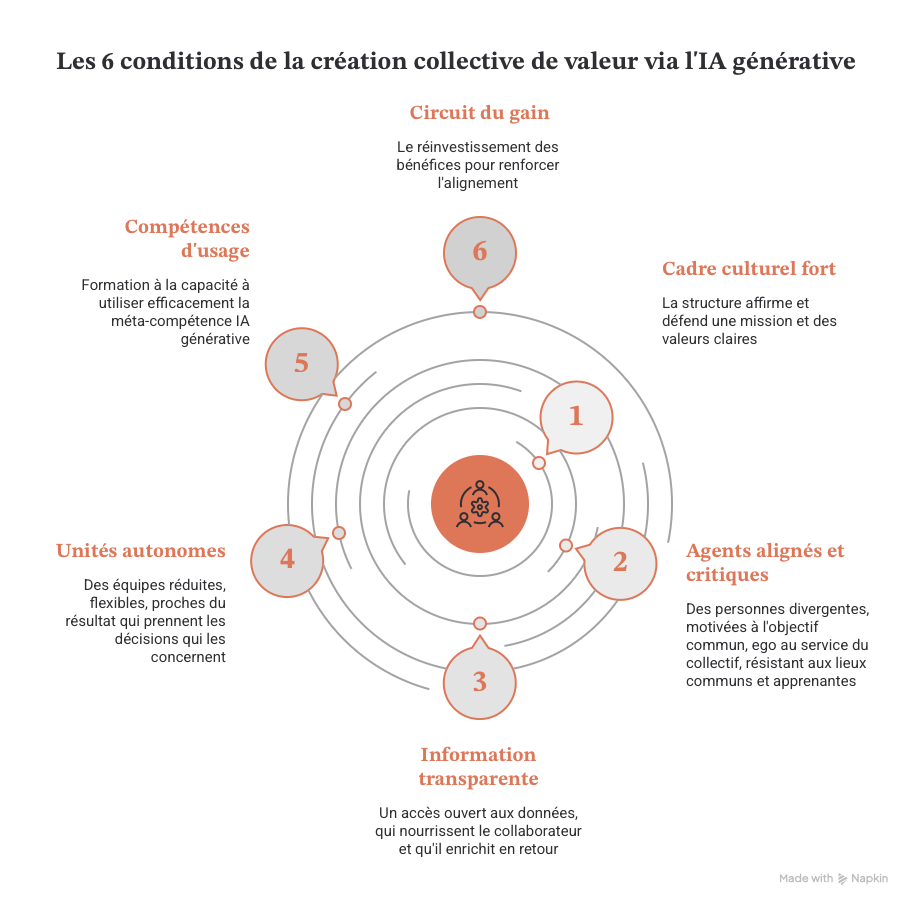
A word on the status of this grid, because rigor demands it. The observations that carry it are established: the measured individual gain, the massive failure of deployments, the underground economy that outperforms, the documented reversals. The grid itself is a hypothesis, the most probable I can build from this bundle, consistent with what management research establishes elsewhere about the organizational conditions of value. It asks to be tested. I come back to that in closing.
What these conditions cost
Reread the grid. Count what it takes away. Every condition is a lever of power you let go.
Each condition has a price, and that price is not paid in money.
Renunciation 1. The frame: a culture that costs
A value you have never paid for is not a value. It's set dressing.
A named culture has the power to align only if it is true, that is, if it shows in daily life and costs something when it is put to the test. The opposite has a name, washing, and everyone smells it from ten meters off: values displayed in the lobby and contradicted at the first budget trade-off align no one, they teach cynicism. The proof by ordeal has just taken place before our eyes. In the winter of 2026, the Pentagon demanded that Anthropic lift its safeguards on autonomous weapons and mass surveillance, ultimatum in hand. The company refused, and the refusal cost it: a contract with a $200M ceiling terminated, a supply-chain risk designation, and the order given to federal agencies to part with its products.[31][32]
"We cannot, in good conscience, accede to their request." Dario Amodei, CEO of Anthropic, February 2026.
Read this refusal with the grid: a mission that bends at the first big contract stops aligning anyone, and the bill for betrayal, departures, distrust, disengagement, far exceeds the bill for renunciation. A true culture is known by this, that it costs, and that you pay it anyway.
Renunciation 2. The people: giving up distrust
Hiring trust before performance. Few leaders dare.
Hiring the well-placed ego before individual performance means giving up distrust as a mode of management, and distrust is comfortable: it justifies the controls, the sign-offs, the reporting. Hiring people you trust before people who perform means accepting that the decision is made without you, and holding when it is not the one you would have made. It also means giving up the pleasantness of meetings that nod along: people with a well-placed ego disagree, and disagree well, which requires a leader able to hear it.
Renunciation 3. Information: giving up asymmetry
Knowing everything before everyone else is power. Sharing it means giving that up.
This is the most intimate renunciation. Absolute transparency takes from the leader the asymmetry that grounds part of their power: knowing what others do not, dosing what you share, keeping a hand on who accesses what. And it imposes something else, rarely said: ethics. A transparent organization can no longer say one thing and do another, since everything is seen. Transparency is a permanent test of consistency between the stated culture and the real decisions: it kills the double discourse, and that is exactly why it is refused.
Renunciation 4. Skill: giving up indispensability
People gladly document what they know. As long as it doesn't cost them their place.
This price is paid in time and in ownership. Training a whole team means whole days subtracted from production, an investment with no immediate return that the budget temptation always pushes to the next quarter. And institutionalizing know-how means asking each person to document what made them indispensable: you only agree to give your advantage to an organization you know will give it back. Trust again.
Renunciation 5. Form: giving up control
Autonomy has a price: letting others decide without you, and sometimes wrongly.
The autonomy of units takes away central control, the cascading sign-offs, the comfort of the escalated decision. Trusting a team to settle things on the spot means accepting that it gets it wrong sometimes, and that its mistakes are the price of its speed and its commitment. Control reassures; it bills its peace of mind in delays, in disengagement, and in lost gain.
Renunciation 6. The gain circuit: giving up extraction
Returning the gain means returning the credit too. Headquarters hates both.
This is the renunciation that two centuries of habit make almost unthinkable: giving up extracting the surplus upward, toward the margin, toward headquarters, toward the funder. And with it, its symbolic twin: recognition. Returning the gain also means naming who produced it, making merit visible instead of dissolving it into a consolidated result that leadership presents as its own. Recognition is the currency of the circuit: an organization that captures the gain and the credit at the same time teaches its members that producing for it means disappearing.
Now add the cost column, and look at the total in the face: redesign of decision channels, training for everyone, documentation, time spent on transparency, contracts refused in the name of culture, control given up. Adopting AI can cost, in restructuring, far more than it returns in the short term: that is the J-curve in all its rigor, the trough before the gain.[16] But it must be said with the same clarity: this cost is not an option. It is the entry price, the sine qua non without which the meta-skill stays a private affair, a capability your people deploy elsewhere. You cannot have the gain without the restructuring, and the restructuring without the renunciations.
That is why the best-resourced organizations fail the most, and that is what the transformation market will never tell you: these six conditions are not settings. They are renunciations. A budget buys licenses, audits, training, platforms. No budget buys the renunciation of a lever of control. Preparation is an expense; alignment is a concession. And it is a concession that the very architecture of most organizations, built to concentrate information, centralize decision and send the gain back up, is designed to prevent. Your organization is not waiting for AI. It was built against it.
These conditions cannot be bought. They have to be conceded.
The balance of power that makes this concession inevitable, I laid out in BYOAI, when the worker brings the machine and in Where there's a way, there's a will: the means of production changed hands, and the new capability awakened wills that nothing contained anymore. The organization no longer commands the capability of its members by contract. It obtains it by consent, and consent is renegotiated in silence, every day. The employee who does not grant it does not go on strike. They move their capability to where the loop closes: the association, the town hall, the friends, the household, the evening project, and one day independence. The dispossession is already under way. It makes no noise. It makes silences around the table.
There remains a question I do not want to dodge: can whole organizations be built on these six conditions, rather than conceding them at the margin? Legal forms exist that inscribe the sixth condition, the hardest, into their very bylaws. In the social and solidarity economy, the collective-interest cooperative society must allocate at least 57.5% of its result to indivisible reserves, often the whole, decides on the principle of one person, one vote, and brings into its capital both employees and beneficiaries.[33] The gain there is reinvested by construction, not by virtue. I am not saying the cooperative is the universal answer: I observe that it is, alongside the research lab, the form that most resembles the grid, and that neither was designed for AI. It is a lead, not a conclusion.
This grid is a hypothesis, I have said so. A hypothesis is tested. I am working to confront it with the field, organization by organization, condition by condition, with the same demand as for any protocol: looking for what refutes it, not what flatters it. The organizations that would measure themselves against it, the researchers who would contradict it, the good-faith opponents: the door is open. A thought that refuses the test is worth no more than the promises it denounces.
The question is no longer: is your organization ready for AI? The question is: does your organization deserve what your people are already doing with it?
Sources
- Field observations collected by KiXiT, training sessions and engagements 2024-2026, more than 350 professionals supported per year. [link: https://kixit.ai]
- Amartya Sen, Commodities and Capabilities, North-Holland, 1985, and Development as Freedom, Oxford University Press, 1999: capability, or the real freedom to achieve what a person has reason to value. Overview: Stanford Encyclopedia of Philosophy, "The Capability Approach".
- MIT Project NANDA, "The GenAI Divide: State of AI in Business 2025", July 2025. 52 executive interviews, 153 leadership survey responses, more than 300 deployments analyzed.
- Microsoft & LinkedIn, "AI at Work Is Here. Now Comes the Hard Part. Work Trend Index 2024", May 2024. Survey of 31,000 professionals across 31 countries.
- Donghyun Suh, Samil Oh, "Generative AI and the Reallocation of Time: Productivity, Leisure, and Fulfilling Work", arXiv:2602.12695, February 2026. Representative survey of Korean workers.
- Entrepreneur, "Klarna Is Hiring Customer Service Agents After AI Couldn't Cut It", May 2025. Sebastian Siemiatkowski acknowledging lower quality.
- Entrepreneur, "IBM Replaced Hundreds of HR Workers With AI, According to Its CEO", May 2025. Arvind Krishna: total headcount went up.
- CNBC, "Meta announces 5% cuts targeting low performers. Read the memo", January 14, 2025.
- Macrotrends, "Meta Platforms: Number of Employees", data from SEC filings, accessed June 2026.
- TechCrunch, "Meta to cut 10% of jobs, or 8,000 employees", April 23, 2026. Janelle Gale's memo as relayed by Bloomberg: "run the company more efficiently and to allow us to offset the other investments we're making".
- NPR, "Meta slashes 8,000 jobs as it pivots towards AI", May 20, 2026. Execution of the cuts and redeployment of part of the workforce to AI teams.
- Gartner, "Gartner Predicts Half of Companies That Cut Customer Service Staff Due to AI Will Rehire by 2027", February 3, 2026.
- Erik Brynjolfsson, Danielle Li, Lindsey Raymond, "Generative AI at Work", Quarterly Journal of Economics, vol. 140, no. 2, May 2025. Study of 5,179 support agents.
- METR, "Measuring the Impact of Early-2025 AI on Experienced Open-Source Developer Productivity", arXiv:2507.09089, July 2025. Randomized controlled trial, 16 developers, 246 tasks.
- METR, "We are Changing our Developer Productivity Experiment Design", February 24, 2026. Update indicating a probable speed gain with late-2025 tools.
- Erik Brynjolfsson, Daniel Rock, Chad Syverson, "The Productivity J-Curve: How Intangibles Complement General Purpose Technologies", NBER Working Paper 25148.
- Eleanor Wiske Dillon, Sonia Jaffe, Nicole Immorlica, Christopher T. Stanton, "Shifting Work Patterns with Generative AI", arXiv:2504.11436, Microsoft Research and Harvard Business School. Six-month randomized experiment on 7,137 workers.
- Anthropic, "The Long-Term Benefit Trust", official announcement of the fiduciary governance structure.
- Anthropic, "Careers, hiring process", accessed June 2026.
- Trending Topics, "Anthropic Overtakes OpenAI in Revenue, Hitting $30 Billion Run Rate", April 7, 2026.
- Epoch AI, "Anthropic and OpenAI earn more revenue per employee than major public tech companies", May 2026. Estimated revenue per employee: Anthropic ~$14M, OpenAI ~$6.5M, above any tech company in the Forbes Global 2000.
- Calvin French-Owen, "Reflections on OpenAI", July 2025. Inside account by an engineer of the organization and culture.
- MLQ, "Mistral AI surges revenue 20-fold to over $400 million ARR", January 2026.
- Recode China AI, "DeepSeek and Moonshot: The AI Labs That Refuse to Be Defined", analysis of DeepSeek's internal organization: flat structure, no individual metrics, free access to compute.
- Stanford HAI, "AI Index Report 2025", Research and Development chapter: the majority of new AI PhDs join industry.
- Entrepreneur, "Mark Zuckerberg Reportedly Made One Person a $1.5 Billion Job Offer", 2025. Individual offer reportedly made to Andrew Tulloch (Thinking Machines Lab) over six years, declined; Meta disputes the figure.
- Trajectoires Tourisme, "Comment l'IA s'est invitée dans notre office de tourisme", August 28, 2025. First-hand account by the team of the Pralognan-la-Vanoise tourist office; training designed and led by Jean-Jérôme Danton.
- Église protestante de Genève, "Organisation": presbyterian-synodal system, parish councils elected by the base, the Consistory.
- Église protestante de Genève, "Les finances de l'EPG": no state subsidy since 1907, funded by donations, three-quarters of the budget going to salaries.
- Le Temps, "L'Église protestante de Genève face à de graves difficultés financières", February 2023. Around thirty parishes, donations in decline.
- CNN Business, "Anthropic rejects latest Pentagon offer: "We cannot in good conscience accede to their request"", February 26, 2026.
- CNN Business, "Trump administration orders military contractors and federal agencies to cease business with Anthropic", February 27, 2026.
- Les Scic, "Qu'est-ce qu'une Scic ?", Confédération générale des Scop et des Scic: indivisible reserves, democratic governance, multi-stakeholder membership.
- Built In, "Meta Superintelligence Labs: What We Know So Far", 2026. Structure, hiring packages, departures.